

Running Warm-Up
New to running? Not sure how to safely get started? Then this article is for you!
Running has become increasingly “trendy” over the past several years. It’s easily accessible, a good social activity, and let’s be honest, run clubs are the new social hangouts.
Although this trend may seem relatively new with running influencers taking over social media, it has been going on for longer than you might think. This is largely due to an increase in women and older runners! For example, over the last decade, the ratio of male to female participation in the New York Marathon has decreased, and in the age group of 20-29 year olds, there was actually a reversal – there were more females than males! This stands in stark contrast to when Kathrine Switzer became the first woman to officially enter and complete a marathon in 1967.
With this increase in running participation, the discussion of injury risk and prevention must also be addressed. This is especially important for newer runners – as novice runners are at significantly higher risk of injury compared with recreational runners. Those first 8-12 weeks of running are when it’s most important to be aware of running specific injury prevention methods as your body is still adapting to the physical demands of running. Reducing your injury risk in those early days is even more important when you consider that the primary risk factor for a running-related injury is a previous running injury within the last 12 months.
An important place to start with your injury prevention journey is before you even go out on your run – the warm-up.
Following the warm-up outlined below can help make those first few kilometers of your run feel less stiff and is a good first step in reducing your risk of injury. Notably, if you’re just going for an easy run, it’s also perfectly acceptable to start running slower at first and ease into the run; however, if you’re going for a hard, fast, or long run, then keep in mind the benefits and importance of starting with a warm up.
Dynamic Stretches
- High knee hug (8-10 total)
- Hamstring leg sweeps (8 per side)
- Open + close the gate (8-10 total)
- Lunge with side bend (8-10 total)
- Windmill stretch (8-10 per side)
- Leg swings – sideways and forward/backward (8-10 per side/direction)
- Body weight squat + calf raise (8-10 total)
- Side lunge (4-5/side)
Explosivity
- Walking A skip (8-10 total)
- Heel kicks (20 total)
- Forward & backward jumping jacks (20-30 sec)
- Pogo jumps (20-30 sec)
Other considerations
10% Rule
Increasing your weekly distance and running frequency by too much can be a risk factor for running-related injury. If you’re just getting started, try starting out with run/walk intervals (e.g., run 5 minutes, walk 2 minutes, and repeat x4). Once you’re steadily increasing your running distance, it is best not to change too many factors at once (e.g., distance, speed, elevation) – use a rough guideline of increasing distance by 10% per week.
Polarized Training: 80/20 Guideline
80% of your runs should be slow and aerobic while 20% can be threshold or above. Threshold can be thought of as the point where breathing becomes laboured, and it is difficult to complete sentences; however, it is recommended to build a solid base before adding speed work.
Periodization
Don’t train hard all the time! This can increase your chances of burning out physically and mentally. As an example, in one month, have 3 weeks of a build-up period followed by 1 week of recovery where the mileage and intensity are decreased.
Nutrition & Sleep
Eat and sleep enough to allow your body the time to recover so it has plenty of energy to fuel your runs!
Resources
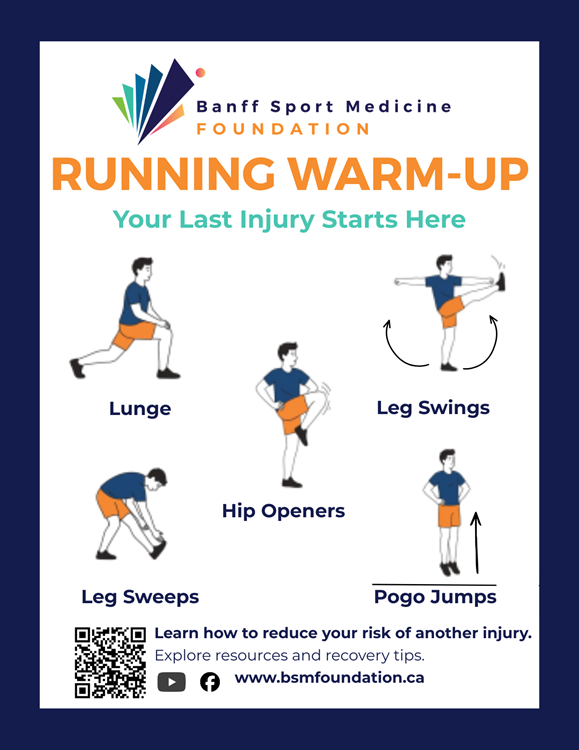
Warm-Up Postcard: Download here
- PRESENTATION: Building Resilience for Running
- ARTICLE + EXERCISES: Trail Running & ITB Pain
- ARTICLE: Running and knee osteoarthritis
- PRESENTATION + TIPS: Nutrition for your mountain adventures
- ARTCLE: A Sport Med Doc’s Top 5 Injury Prevention Tips for Runners
- ARTICLE: The road to recovery: insights from an injured Sports Medicine Doc & ultramarathon runner
- Health Library Injury Prevention & Management resources
Contributing Expert
Tara Vermeulen, BSc Honours Neuroscience, University of Alberta.
References
Fitzsimmons, B., Mason, A., Nesburg, R. A., & Hunter, S. K. (2022). Increased Marathon Participation In The Last Decade Is Driven By Women And Older Runners. Medicine & Science in Sports & Exercise, 54(9S), 475–475. https://doi.org/10.1249/01.mss.0000881036.60003.37
Saragiotto, B. T., Yamato, T. P., Hespanhol Junior, L. C., Rainbow, M. J., Davis, I. S., & Lopes, A. D. (2014). What are the Main Risk Factors for Running-Related Injuries? Sports Medicine, 44(8), 1153–1163. https://doi.org/10.1007/s40279-014-0194-6
Videbæk, S., Bueno, A. M., Nielsen, R. O., & Rasmussen, S. (2015). Incidence of Running-Related Injuries Per 1000 h of running in Different Types of Runners: A Systematic Review and Meta-Analysis. Sports Medicine, 45(7), 1017–1026. https://doi.org/10.1007/s40279-015-0333-8