
Closing the Memory Gap: Helping Patients Understand & Remember Their Care
Good healthcare communication doesn’t end when the appointment does.
In our previous article, The Memory Gap in Healthcare, we looked at an important challenge in healthcare: patients often forget some of the information given to them during an appointment.
Medical appointments can be stressful. There can be a lot of new information to take in, unfamiliar medical terms to understand, and important decisions to make. It’s easy to leave an appointment feeling like you understood everything, only to realize later that you can’t remember exactly what your healthcare provider said.
So, what can we do about it?
There are simple ways healthcare providers can help patients better understand, remember, and use the information they receive.
Check understanding using the “teach-back” method
One of the most useful tools is called teach-back.
Teach-back is a simple way for healthcare providers to check whether a patient has understood the information provided. Instead of asking, “Do you understand?”, the provider asks the patient to explain the information back in their own words.
For example, after explaining how to care for an injury, a healthcare provider might say:
“I want to make sure I explained that clearly. Can you tell me what you’ll do when you get home?”
The goal is not to test the patient, but to see how clearly the information was explained. If the patient is unsure or gets something wrong, the healthcare provider has a chance to explain it again in a different way.
This creates a simple communication loop:
Explain → Ask the patient to explain it back → Clear up any confusion → Confirm understanding.
Research has found that teach-back can improve understanding and recall of health information. It has also been linked to better following of treatment plans, greater patient satisfaction and trust, and fewer calls or return visits caused by misunderstandings.

It only takes a few minutes
One reason healthcare providers may not use teach-back is the concern that it will make appointments longer.
However, research suggests that teach-back can often be done in just one or two minutes. The goal is not to repeat everything discussed during the appointment. Instead, it focuses on the most important information the patient needs to remember.
Those extra minutes may also save time later by reducing confusion, follow-up calls, and repeat visits.
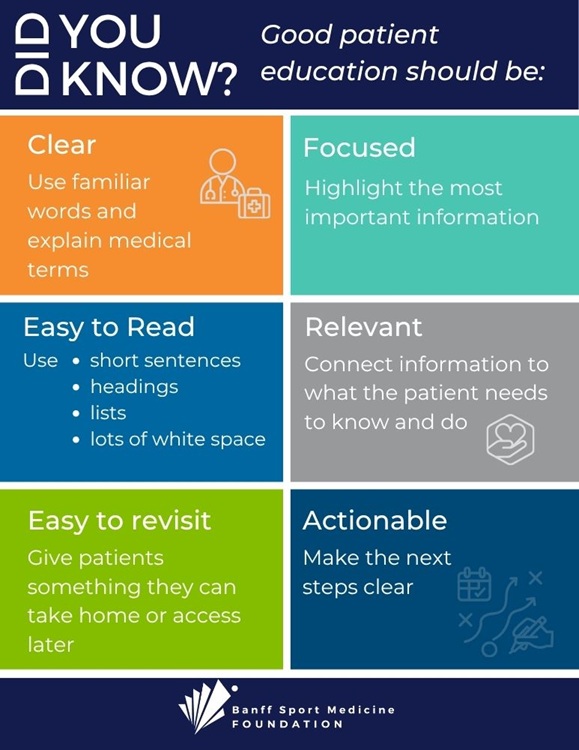
Use words patients can understand
Another important part of good communication is plain language.
Healthcare providers use medical terms every day. For patients, those same words can be confusing. Instead of complex medical language, using familiar words to explain medical terms and examples that connect to everyday life can help improve a patients understanding.
For example, instead of saying: “You have an inflammatory response in the patellofemoral joint.”…
…. a provider might explain: “The tissues around your kneecap are irritated and swollen.”
The information is still accurate, but easier to understand.
Using simple language does not mean “dumbing down” healthcare. It means making sure important information is accessible to the people who need it.
It can also help to focus on a small number of key points rather than giving patients too much information at once. Analogies and everyday examples can make unfamiliar ideas easier to understand.
Give patients something they can take home
Even when information is explained clearly, people may not remember everything from an appointment.
That is where written information can help.
Handouts, after-visit summaries, and other written resources give patients something they can look at again when needed.
This can be especially helpful after an appointment when a patient is trying to remember:
- What is my diagnosis?
- What should I do next?
- What activities should I avoid or change?
- What exercises should I do?
- When should I follow up?
- What should I watch for?
Written information gives patients the chance to review important details at their own pace. But there is an important catch.
Written information only helps if patients can understand it.
Simple does not mean less accurate
Many health resources are written at a reading level much higher than recommended for the general public.
Research looking at patient education materials across healthcare has found that many resources are too difficult to read.
This creates a problem. A resource can be medically accurate and still fail if the person reading it can’t understand what it means.
In Canada, more than 60% of adults have been reported to have less than adequate health literacy. For this reason, it is recommend that patient education materials be written at about a Grade 5 or 6 reading level.
Closing the memory gap is a shared responsibility
The memory gap in healthcare is not simply a problem with patients forgetting information.
It’s also an opportunity to rethink how healthcare information is shared.
Instead of expecting patients to remember everything they hear, we can build communication systems that make understanding and remembering easier.
That means:
- Explain clearly.
- Use plain language.
- Focus on the most important information.
- Ask patients to explain it back.
- Provide useful information they can take home.
These are small changes, but they can make a meaningful difference.
At the Banff Sport Medicine Foundation, we believe that research should be turned into practical tools and information that help people make informed decisions, recover well, and stay active.
Closing the memory gap starts with making healthcare information easier to understand and easier to use when patients need it most.