Functional Testing and the Limb Symmetry Index
DYK that about 1 in 4 young people (aged 25 and under) who tear their ACL will injure it again – either in the same knee or the other one? A big reason for this is uneven strength and movement between the two legs.
If the repaired leg isn’t strong enough, going back to sport and activities too soon – especially activities that involve jumping, pivoting, cutting, or quick direction changes – puts the knee at high risk for another ACL tear.
On the other hand, relying too much on the “good” leg can overload it and increase the chance of tearing the ACL in that knee.
That’s why testing matters. At Banff Sport Medicine (BSM), patients who’ve had a knee reconstruction are tested regularly throughout rehab to track how their recovery is going. This helps the team decide when it’s physically safe to begin returning to sport – gradually…. and in a controlled way.
What is Functional Testing?
Functional testing looks at how well your knee works in real-life movements. It includes hop tests, balance tests, and strength tests that measure how strong, stable, and coordinated each leg is.
The goal is to compare your surgical leg to your non-surgical leg and see if there’s a big difference. If there is, it means more targeted rehab is needed to reduce the imbalance and lower injury risk.
How Testing Works
The tests are done in a specific order:
- Power and coordination tests first
- Fatigue-based tests later
At BSM, hop testing follows this sequence:
- Single-leg hop for distance
- 6-meter timed hop
- Triple hop
- Crossover hop for distance
These movements mimic real sport-related movements and show how well your knee performs under realistic conditions.
What is the Limb Symmetry Index (LSI)?
The LSI is a simple way to measure how similar your two legs are.
It’s shown as a percentage:
- 100% = both legs are equal
- 90% = the surgical leg is 90% as strong/functional as the other leg
Before returning to sport, your injured leg should reach at least 90% of the strength and hop performance of your non-injured leg.
Research shows:
- When athletes reach 90% LSI or higher, about 80% return to their original level of sport
- Returning to sport before reaching 90% makes you four times more likely to re-tear your ACL
The Big Picture
Functional testing and the LSI help measure:
- Strength
- Stability
- Power
- Coordination
- Re-injury risk
- Readiness to return to sport
They don’t just ask, “Can you play?” – they answer, “Is your body actually ready to play safely?”
Recovery Takes Time
Rehab isn’t quick. Even after surgery:
- The new ACL graft takes at least two years to fully mature
- Strength, movement quality, and performance continue to improve for up to two years post-surgery
- Recovery is not only physical, but mental as well – it’s confidence and mindset too
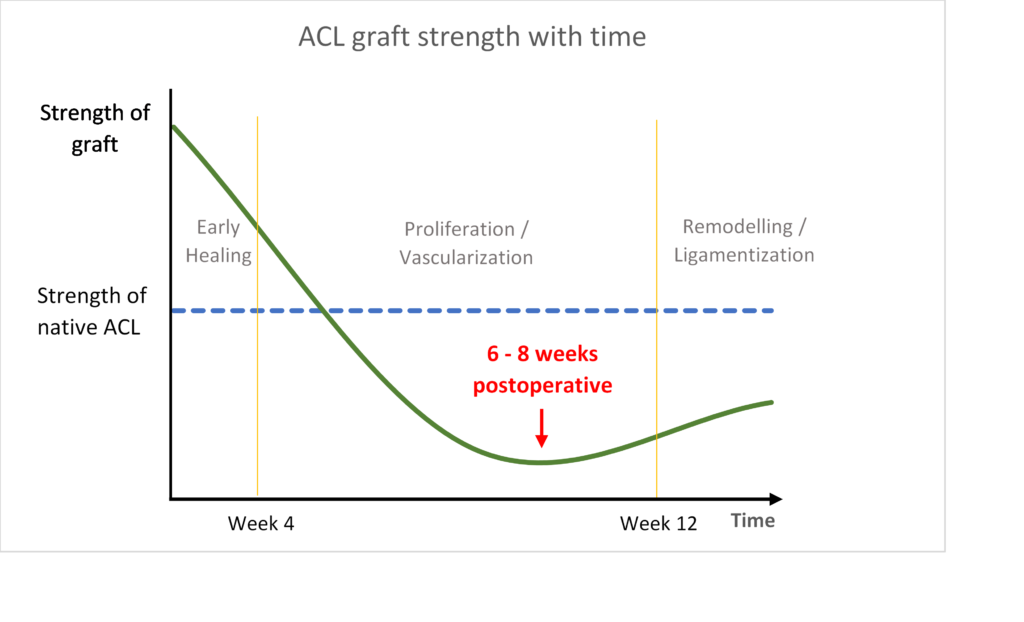
This is why long-term rehab, testing, and guided progression are essential – not just for returning to sport and activities, but for staying healthy in the long-term.